
Memory Care Interior Design: What Actually Works
- Memory care neighborhoods work best when they feel warm and lived-in. Spaces that are stripped down in the name of simplicity often feel less settled, not more.
- Accessory selection in memory care requires more thought than in other areas of a community. What looks fine in a rendering may not hold up to how the space actually gets used.
- The most successful memory care layouts are open, so residents and staff can see across the common areas without having to navigate through them.
- Lighting matters more in senior living than in almost any other setting, and memory care is no exception. Good light supports safety, orientation, and better sleep.
- Furniture and material choices in memory care shift toward durability and ease of cleaning, while still looking and feeling like a home.
Memory care is one of the most specialized areas of senior living design, and one of the most commonly misunderstood. There's a tendency to strip these neighborhoods down under the assumption that simpler is safer for residents with dementia. The result is usually a space that feels more institutional than calming, and less like home than it should.
Good memory care design isn't about removing things. It's about being intentional with every choice. The right colors, materials, furniture, and lighting help residents feel oriented and at ease. Choices made without that context can create friction day to day that isn't obvious until the space is occupied.
Here's what we look at when designing or evaluating a memory care neighborhood, and why these decisions matter as much as any other in a senior living community.
What does good memory care design actually look like?
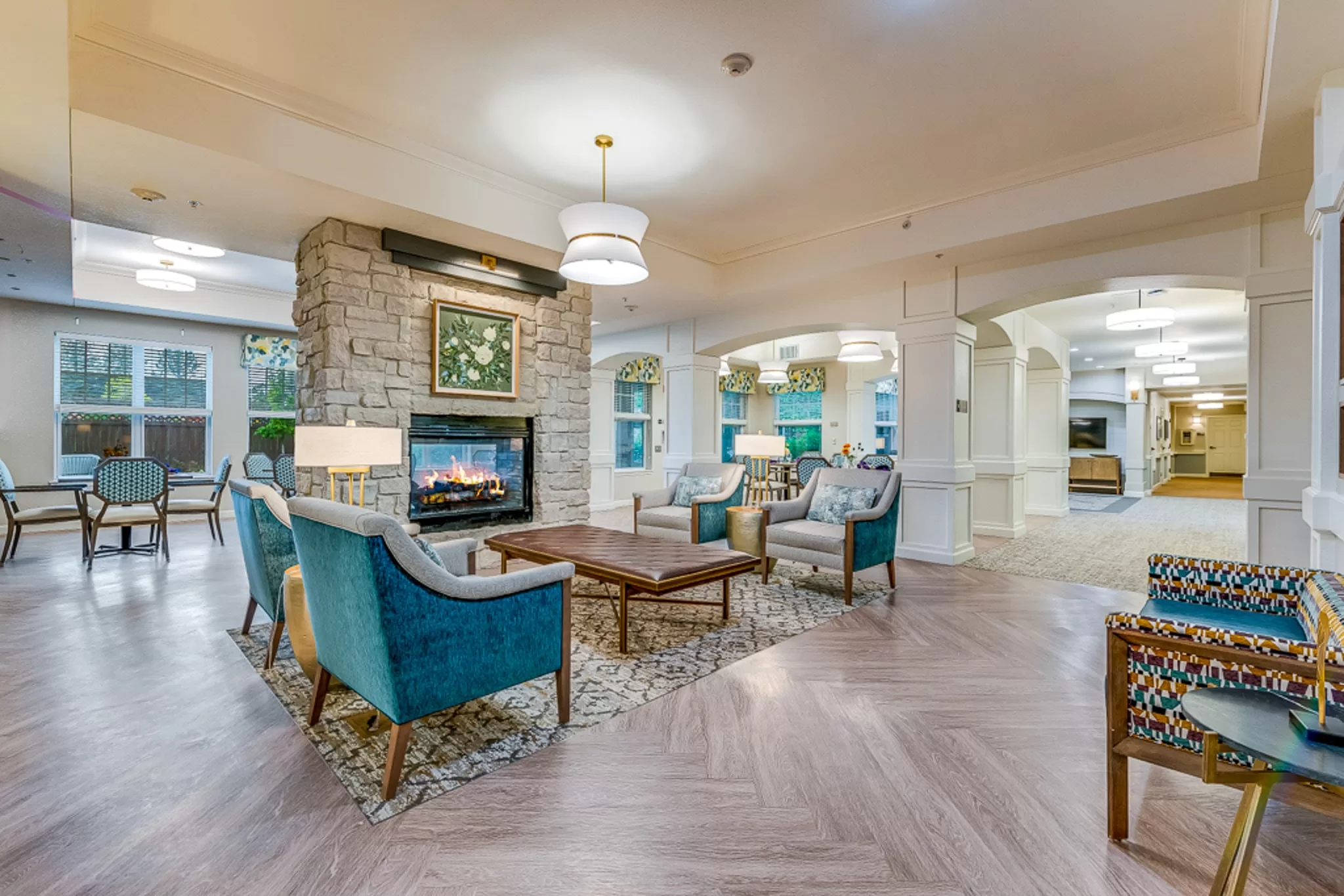
Good memory care design feels warm and residential. Spaces that are overly spare often feel unsettled rather than calm, which works against the residents living there.
One of the most common misconceptions we see is that memory care neighborhoods need to be left bare so as not to overwhelm residents. The thinking makes sense on the surface, but the spaces that feel most calming and livable are usually the ones that feel like a real home, not the ones that have been emptied out.
Designing for someone with dementia doesn't mean designing without color, texture, or personality. It means making thoughtful choices about what goes into a space and why. The neighborhoods we're most proud of have warmth and life to them. Residents and families respond to that immediately on a tour.
When we walk a memory care community that isn't working well, we're usually looking for the same things: whether the space feels welcoming, whether it helps residents feel oriented, and whether the furnishings and finishes are holding up the way they should.
Why does accessory selection matter more in memory care?
Residents with dementia experience their environments differently, and accessories need to be chosen with that in mind. What looks beautiful in a spec may not be the right fit for how the space actually functions.
This is one of the things that catches designers off guard if they haven't spent much time in memory care. People at different stages of dementia interact with their surroundings in ways that aren't always predictable. Agitation can come out in physical ways, and loose objects on tables and shelves are often the first things involved.
That doesn't mean the space has to look sparse or institutional. It means being deliberate about what goes in and what doesn't. Items that are heavier, stable, and less fragile are better suited to a memory care setting than delicate decorative pieces. The space can still feel curated and personal. It just requires more thought about what those choices are made of.
Accessorizing a memory care neighborhood is genuinely one of the more nuanced parts of the work, and it's an area where experience in this specific setting makes a real difference.
How do you help memory care residents find their way around?
Personal cues tend to work better than signage systems in memory care. A small display outside each resident's apartment with photos of family or meaningful objects helps them recognize their space as their own.
Wayfinding in memory care is a different challenge than in the rest of a senior living community. Color-coded corridors and directional signage can support some residents, but for many people with dementia, what's most helpful is something personal rather than something directional.
One of the most consistently effective approaches is a small display outside each resident's apartment door that holds photos of them, their family, or objects that mean something to them. It gives residents a way to recognize their own space that doesn't depend on reading ability or spatial reasoning.
For the common areas, layout does most of the work. The memory care neighborhoods that function best are the ones where dining, living, and activity spaces open into each other so residents can see across the whole area without having to navigate through it. Staff find that easier to work in, too.
Why is lighting especially important in memory care?
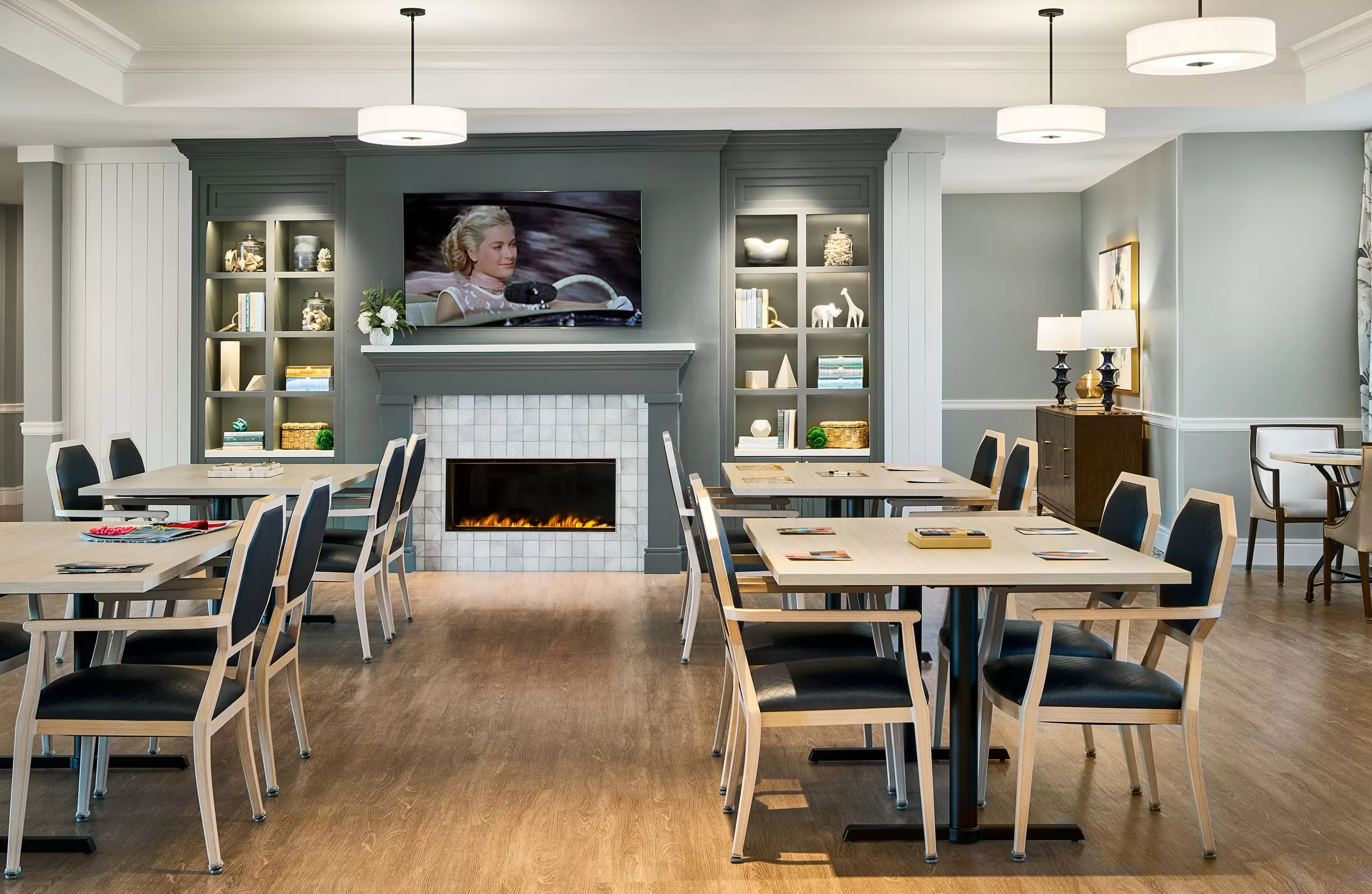
The aging eye needs significantly more light than a younger one. In memory care, good lighting supports safety, helps residents stay oriented, and plays a role in maintaining more consistent sleep patterns.
Lighting is a serious consideration throughout any senior living community, and it carries particular weight in memory care. As we age, our eyes need more light to see comfortably and clearly, and sleep cycles become more fragile. Both of those things are amplified in memory care.
What we're thinking about in these spaces is consistent, layered light that works across different times of day and different parts of the neighborhood. Natural light matters here too. Access to daylight helps support sleep and wakefulness in a way that artificial light alone can't replicate.
For a deeper look at how Aneka Interiors approaches lighting design in senior living communities, explore our full lighting design overview.
How does furniture selection change in memory care?
Memory care furnishings prioritize durability and ease of cleaning while still looking residential. The selections shift meaningfully from what you'd specify in independent living or even assisted living.
In independent living, you might choose woven fabrics on upholstered seating. They look beautiful, they're comfortable, and they work well for that setting. In memory care, those same fabrics are harder to maintain and wear faster under the demands of daily use.
The shift typically looks like this:
- Vinyl upholstery instead of woven fabrics. It cleans easily, holds up to repeated use, and still looks polished and residential when specified well.
- Solid surface tables, like stone and metal combinations, rather than wood. Spills and everyday wear are much less of an issue on a solid surface than on wood that can stain and scratch over time.
- Seating ergonomics stay just as important here as anywhere in senior living. Seat heights, chair arms, and front casters all affect whether residents can sit down and get up comfortably on their own.
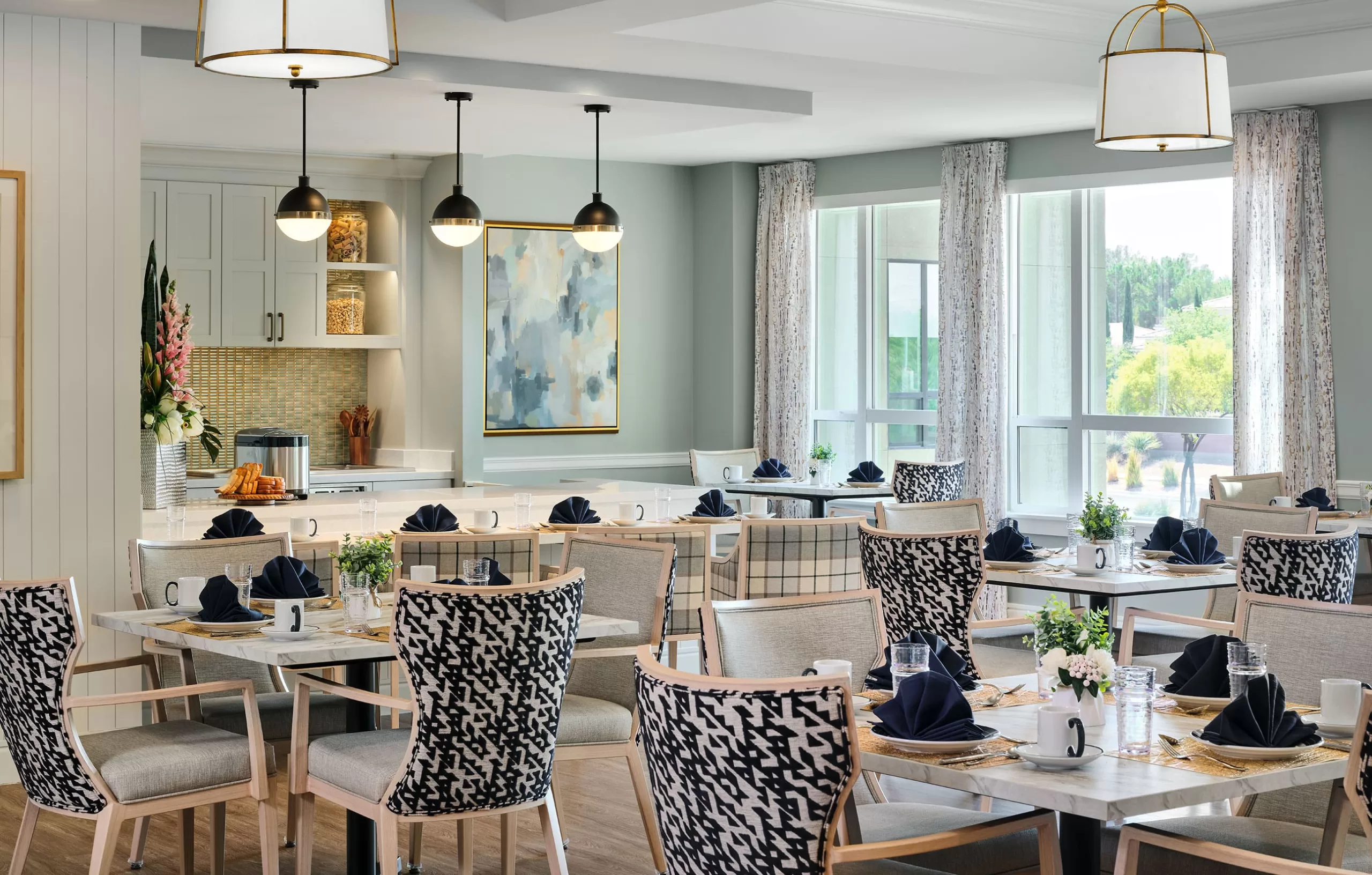
The goal is always a space that looks and feels like home. The underlying selections just need to be built for how that space actually gets used. You can see more about how these considerations shape our work in our post on interior design for senior living.
- Warmth and personality in the space
- Open layouts that help residents see where they are
- Personal wayfinding cues at each resident's door
- Consistent, layered lighting throughout the day
- Furnishings that hold up well over time
- Accessories that aren't suited to a memory care setting
- Spaces stripped down so far they feel cold rather than calm
- Lighting that isn't adequate for aging eyes
- Fabrics and surfaces that don't hold up to daily wear
- Wayfinding designed for residents who can no longer use it
How does memory care design fit into the rest of a senior living community?
Memory care is one neighborhood within a larger community. Design decisions there need to work in context with assisted living, independent living, and shared spaces on the same campus.
Most senior living communities house more than one level of care. Memory care, assisted living, and independent living each have their own design requirements, and a designer working across a full building needs to understand how those differ and where they connect.
For a deeper look at how Aneka Interiors approaches senior living design across the full continuum of care, including how we think about designing for both residents and their families, that context is worth understanding before a project gets underway.
Memory care is where the environment does some of its most important work. When a space supports the people living and working in it, that's not a small thing. It's the whole point.
You can also read more about how we think about sound and lighting design in senior living, both of which are especially relevant in memory care neighborhoods.
Memory care design requires a level of specificity that goes beyond most other project types. If you're planning a memory care renovation or new build and want a design partner who has spent years working in these spaces, we'd love to talk.