Designing for Active Living: How Communities Can Support Vibrant Senior Lifestyles

Key Takeaways

  • Active adult community design prioritizes independence and lifestyle choice, not clinical care. Amenity planning, material specifications, and budgeting all follow from that difference.
  • Residents choosing a 55+ community are making a deliberate lifestyle upgrade. They evaluate spaces the way they would a boutique hotel or a market-rate apartment building, and design has to meet that expectation.
  • The most valuable spaces are designed with enough intention that residents can use them in whatever way fits their day: art class in the morning, book club in the afternoon, without anything feeling makeshift.
  • Tour conversion depends on hospitality-grade design that positions residents as the decision-makers. When a lobby reads as a care setting, prospects disengage before the conversation starts.

Active adult residents are independent, healthy, and highly selective about where they choose to live. They are not moving out of necessity. They are making a deliberate lifestyle choice, and they evaluate communities the way they might evaluate a boutique hotel or a market-rate apartment building.

That distinction shapes everything: the amenities built, the materials specified, the programming supported, and the tour experience that converts a prospect into a resident. Developers who understand this from the start build communities that fill faster and retain residents longer.

What Makes Active Adult Community Design Different from Assisted Living?

Active adult design is built around resident choice and lifestyle. Every space, finish, and amenity decision follows from that priority rather than from a care or safety framework.

It is worth being clear about where active adult sits on the senior living continuum. Independent living communities and assisted living communities each have their own design logic, and active adult is distinct from both. There is no commercial kitchen requirement, no care delivery infrastructure, and no clinical programming to accommodate. The design benchmark is hospitality and market-rate residential, not healthcare.

In practice, this changes how budgets get allocated. Dollars that might go toward clinical infrastructure in a care setting flow instead toward amenity spaces, finishes, and programming environments that drive tour conversion and daily resident engagement. Aneka Interiors’ senior living design practice covers the full continuum, and the most consistent mistake we see in first-time active adult projects is scoping the amenity budget against assisted living precedents. The finish standards, the space mix, and the resident expectation are simply different.

The result of getting that right is a community that feels genuinely residential, not institutional, and that distinction is something prospective residents notice within the first few minutes of a tour.

How Does Programming Drive Design in 55+ Communities?

Programming determines which spaces get built and how large they need to be. In active adult communities, residents participate because they want to, and that self-direction reshapes every square footage decision.

What residents want from a 55+ community has shifted meaningfully over the past decade. Traditional programming like card games and organized crafts has given way to personalized fitness, lifelong learning, volunteer coordination, and creative pursuits. Communities that locked in fixed-use spaces several years ago now find themselves retrofitting floor plans to meet expectations those plans were never designed for.

The spaces that hold up best over time are the ones designed with enough thoughtfulness that they can flex — not because the furniture is on wheels, but because the design itself never dictated a single use. This is an important distinction. The goal is not a generic multipurpose room with stacked chairs and folding tables. The goal is a beautifully finished, intentionally designed space that feels settled and purposeful, and that residents choose to use for art class, book club, bible study, or a small luncheon without anything needing to be reconfigured dramatically.

Connection between indoor and outdoor spaces matters more in active adult design than in most other senior living categories. Outdoor amenities extend programmable square footage and support the active lifestyle residents expect. Walking trails, raised-bed gardening areas, outdoor fitness equipment, and covered patios enable programming that keeps residents engaged without requiring staff coordination for routine use.

What Amenity Spaces Do Active Adult Residents Actually Use?

Fitness centers, pickleball courts, raised-bed gardens, and well-designed social spaces drive the most consistent daily use. Single-purpose specialty rooms tend to underperform unless backed by strong ongoing programming.

Consistently High Use

  • Fitness centers with group class space
  • Pickleball courts (outdoor preferred)
  • Creative and hobby spaces (art, crafts, making)
  • Demonstration kitchens and bars
  • Varied social spaces across multiple scales
  • Covered outdoor patios and walking paths

Underperform Without Programming

  • Formal billiards rooms
  • Oversized dedicated craft studios
  • Woodworking shops
  • Single-purpose theater rooms
  • Any specialty room built on anecdotal demand

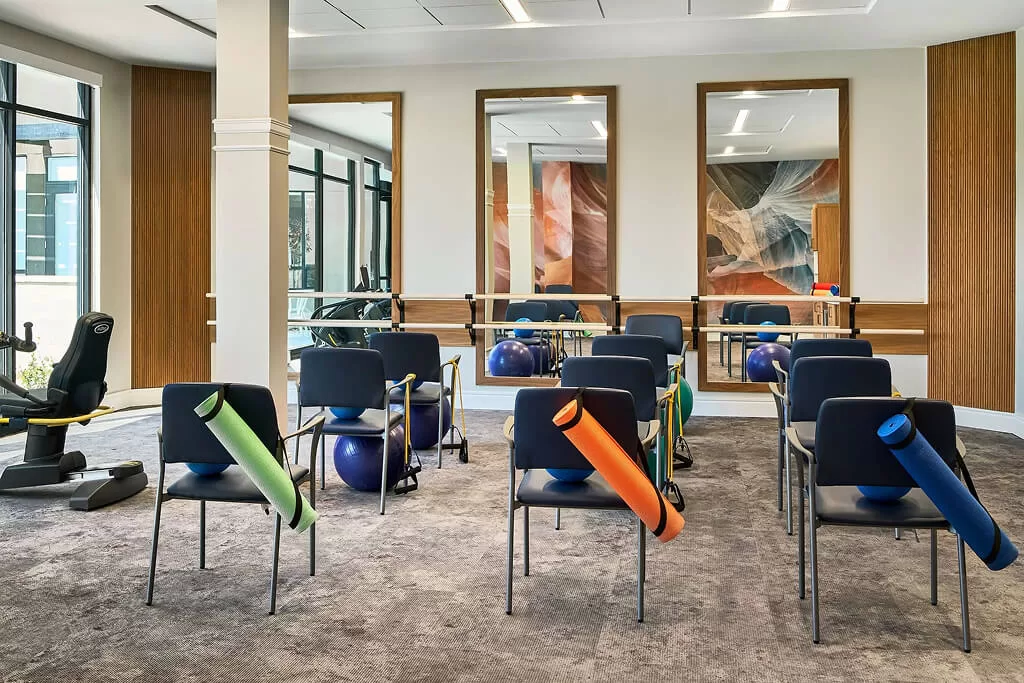
Fitness centers rank among the highest-use amenities in successful active adult communities. These spaces need equipment appropriate for this demographic: recumbent bikes, resistance machines with clear instructions, and open floor space for group classes including chair yoga and low-impact strength training.

Pickleball courts have become a genuine expectation in many markets. The sport appeals to active adults because it delivers social interaction, moderate exercise, and competitive play without the physical demands of tennis. Communities that have invested in courts consistently report that the space drives both tour interest and resident retention.
Outdoor pickleball court at active adult senior living community designed by Aneka Interiors

Creative spaces are one of the more underappreciated drivers of community engagement, and one of the places where design intention makes the biggest difference. When these rooms are designed to feel residential rather than purpose-built for a single hobby, they tend to become some of the most-used spaces in the community.

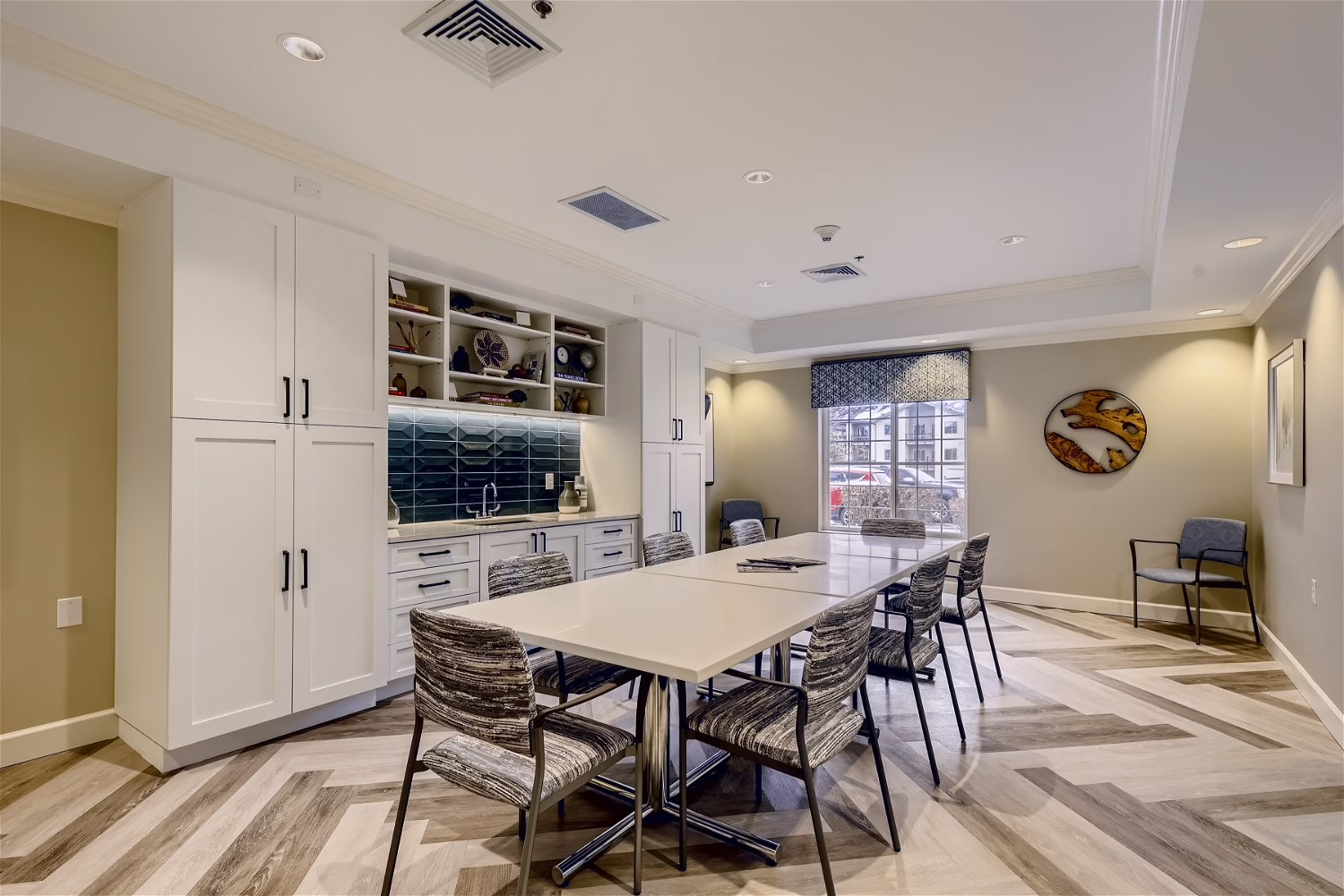
One project we worked on recently is a good example of this. A private dining room that had gone largely unused was converted into an art and craft space. Residents loved it immediately — not just for art, but for book club, bible study, and small luncheons. The reason it worked for all of those things is that we were deliberate about not designing it to feel like a craft room. There are no industrial sinks, no heavy-duty storage units dominating the walls, no visual cues that say “this is where you come to do crafts.” Instead, the space has refined cabinetry, hospitality-grade furnishings, display shelving for resident work, and LVT flooring in a herringbone pattern that would look at home in any well-designed residential interior. When residents walk in for book club, it feels like a gathering room. When they come in for a painting class, it feels like a studio. The design carries both uses without strain.

Social spaces outperform activity spaces when designed thoughtfully. Successful communities create varied settings that support different group sizes and interaction styles: quiet conversation corners for a coffee with one neighbor, larger gathering spaces for community events, and rooms that can serve both. What residents respond to is variety: spaces that feel genuinely distinct from each other rather than institutional variations on the same lounge.
Modern meeting room with a long table and six chairs, built-in cabinets, open shelves with decor, parquet flooring, and a large window with city view. Neutral tones and contemporary art create a stylish, inviting space.


How Do Material and Finish Requirements Differ in Active Adult Design?

Active adult communities require residential-grade materials that read as hospitality, not healthcare. The goal is durability without any of the institutional cues that create the wrong first impression.

Flooring sets the tone for the entire community. Active adult communities use luxury vinyl tile (LVT) that mimics hardwood or stone. It performs well under heavy foot traffic and occasional spills while reading as residential rather than clinical. In higher-end communities, actual hardwood works well in living areas where moisture is not a concern.

Color palettes should reflect current residential trends rather than timeless neutrals chosen to be inoffensive. Active adult residents notice when finishes look dated or institutional, and they expect design that feels contemporary and considered. Lighting design works with color to create spaces that feel energizing rather than calming, which matters to active adults evaluating a lifestyle upgrade.

Furniture in common areas needs to balance comfort with durability. Hospitality-grade upholstery withstands heavier use and spot cleaning better than residential fabric, but the forms should come from residential and boutique hotel precedents, not healthcare furniture catalogs. Ergonomics matter, but they do not have to look clinical. Appropriate seat heights and supportive arm rests can be built into beautiful furniture without announcing their function.

Demonstration kitchen and bar finishes should match or exceed what residents had in their previous homes. Quartz countertops, quality appliances, and proper task lighting signal that the community values good food and social dining. Cheap finishes in these high-visibility spaces communicate a lifestyle downgrade, and residents notice. Sound control deserves equal attention: acoustic panels, area rugs, and sound-absorbing ceiling treatments address age-related hearing changes without compromising the residential feel.

Where Do Active Adult Tours Lose Momentum, and How Does Design Help?

Most tour momentum is lost in the first ninety seconds. When a lobby reads as a care setting rather than a lifestyle destination, prospects disengage before the conversation starts.

Three places where tours consistently lose momentum each have a clear design-side fix.

The lobby reads as a care setting. Handrails mounted to lobby walls, LVT in clinical patterns, pastel color schemes, and reception desks that resemble nursing stations all communicate “care community” before anyone says a word. Hospitality precedents should guide every entrance design decision: concierge-style reception, residential lighting, quality seating, and materials like wood, stone, and metal create the first impression of a lifestyle upgrade.

Common areas look empty. Prospects touring on a Tuesday morning need visible evidence that residents engage with the spaces being shown. Scheduling programming during peak tour windows and keeping activity calendars visible turns empty rooms into social proof.

Model units feel too staged. Apartments with minimal personal items make it hard for prospects to picture their furniture, their art, and their life in the space. Books, hobby items, and family photos displayed naturally outperform any pristine model presentation when it comes to driving deposit decisions.

How Does Aneka Interiors Approach Active Adult Community Design?

Aneka Interiors treats every active adult project as its own category, separate from assisted living and conventional multifamily alike. The work starts with understanding what the residents in that specific market actually want to do with their days.

One of the patterns we see most often in first-time 55+ projects: the amenity budget gets scoped against assisted living precedents. Too much capital goes toward infrastructure that active adult residents do not need, and too little goes toward the hospitality-grade finishes and flexible spaces that actually drive tours. When we shift the competitive benchmark from senior housing to market-rate apartments, the entire specification approach changes, and so does the leasing outcome.

Aneka’s senior living design practice spans new construction and renovation across the active adult, independent living, and assisted living segments. The measure of a successful active adult community is whether the spaces drive tour conversion, support daily resident engagement, and hold up operationally over the life of the asset. Those are the outcomes we design toward.

Active adult community design requires specialized expertise because the segment differs from both assisted living and conventional multifamily. Developers who approach it with either framework often end up with amenity spaces that underperform on tours and communities that never quite feel vibrant once occupied.

If you are scoping a first 55+ project or evaluating an existing community for repositioning, we are glad to talk through what the programming and design approach would look like for your specific market.

Contact Aneka Interiors to discuss your active adult community project.